
Overview
Growth factor concentrate, or GFC, is prepared from your own blood and intended to concentrate growth-factor signals before they are placed in the scalp. It belongs to the same family of ideas as platelet-rich plasma. Processing differs. The type of hair loss still has to be known first. GFC is a listed hair service at AB Skin Clinic. Dr. S. Madhuri separates pattern hair loss, telogen effluvium, and other diagnoses. Evidence that GFC or PRP regrows hair is mixed and patient-dependent. GFC does not cure scarring alopecia or rebuild hair on fully bald skin.
Concerns this visit may address
This visit is for a widening centre part, a thinner crown in bright light, temples that have crept back, or a diffuse shed that has lasted long enough to worry you. Breakage from styling can look like hair loss and will not respond to injections. If someone has suggested surgery, you can still start here. The named procedures on the service menu are PRP for hair and GFC. The homepage notes that restoration may include surgical and non-surgical options. Any surgical discussion would happen only after assessment. This page is not a transplant programme.
Who may benefit from an evaluation
You may benefit if thinning is early and follicles are still visible. Heavy shedding a few months after illness, childbirth, or a strict diet may be telogen effluvium and may need tests and time rather than GFC. GFC is often the wrong step when the scalp shows scarring, pustules, or a smooth hairline typical of scarring alopecia. Bleeding disorders, very low platelets, scalp infection, and pregnancy are reasons to pause.
Possible contributing factors
Pattern hair loss is driven by inherited follicle sensitivity and shows miniaturisation in a recognisable distribution. Telogen effluvium follows a trigger that pushes many follicles to shed together. Thyroid disease, iron deficiency, and some medicines contribute in selected patients and are looked for when the history fits. Traction, heat, and chemical damage cause breakage that can mimic thinning. Inflammatory scalp disease and fungal infection increase shedding and need their own treatment.
How a dermatologist evaluates the concern
Expect a history that dates the change, a look at the partition and hairline, and dermoscopy for miniaturised hairs, broken shafts, or scarring. Bring recent labs if you have them. The dermatologist then names the leading diagnosis. GFC is discussed only if living follicles are present and a growth-factor procedure is reasonable to consider. Scarring disease redirects the plan. Telogen effluvium may be watched. Pattern hair loss may be treated with medicines, with or without a procedure. See the wider list of hair treatments.
Treatment approaches that may be discussed
Discussion can include scalp care for dandruff or dermatitis, treatment of a proven deficiency, topical or oral therapy for pattern hair loss when appropriate, PRP, and GFC. A course, if chosen, is scheduled with reviews. One injection is not a complete treatment. Surgical restoration is not booked from this page.
How the treatment works
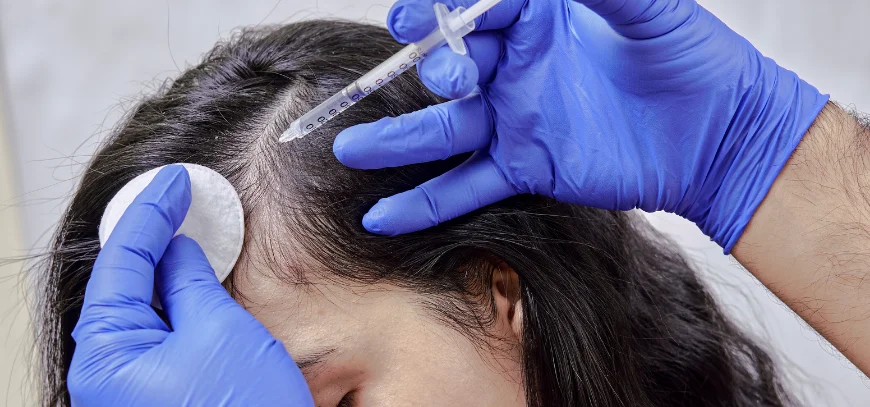
Blood is drawn from you and processed to obtain a fraction intended to concentrate growth factors. That fraction is injected in small amounts across the thinning scalp. The theory is similar to PRP: signals around a shrinking follicle may support thicker growth. Spin speeds and volumes are not listed here. New follicles are not created in scar or in a long-bald area.
What happens during a consultation or procedure
The first appointment is diagnostic. If GFC is suitable and you consent, a procedure may be arranged the same day or later. Consent includes pain, bruising, and the chance of no visible regrowth. Blood is collected, the concentrate is prepared, and small injections are placed in the mapped zone. The visit is outpatient. You receive aftercare for washing and exercise. If dermoscopy later shows scarring, or shedding has a new explanation, the plan changes. Book an appointment and ask for hair loss to be diagnosed before any procedure.
Preparation guidance
Come with a clean scalp if instructed, and with hair that can be parted. Bring a medicine list, prior reports, and the names of any PRP or GFC sittings done elsewhere. Mention anticoagulants, platelet disorders, pregnancy, breastfeeding, and scalp boils. Hours are Monday to Saturday, 10:00 am–1:00 pm and 6:00 pm–8:30 pm; Sunday is closed. Contact the clinic if you need to move the day.
Aftercare and recovery
Leave injection points untouched and delay shampoo for the interval you were given. Skip swimming, saunas, and intense exercise for the advised period. Tenderness or a dull headache usually fades. Return to ordinary washing gently, and restart prescribed topicals only on your own schedule. Call for fever, pus, or worsening pain. The meaningful review is measured in months, with photographs.
Risks, limitations, and realistic expectations
Short-term effects include pain, swelling, bruising, and, rarely, infection. Mixed evidence means a visible response cannot be promised. GFC does not cure scarring alopecia, cover a fully bald area, or repair breakage from heat. A realistic result is a clear diagnosis, a course only where follicles remain, and permission to stop if coverage does not change.
What influences suitability and results
Diagnosis and the dermoscopic presence of follicles matter more than the kit name. Duration of thinning, family pattern, smoking, and ongoing traction matter. Active dermatitis or infection should be quiet before injections. A documented blood abnormality redirects care. People seeking regrowth on a bald crown are not suitable candidates for GFC as a regrowth method. Your dermatologist may prefer PRP, GFC, a sequence, or neither.
Why professional dermatology guidance matters
Growth-factor treatments are easy to advertise and easy to misapply. A dermatologist’s role is to decline them when the scalp shows scarring, when the shed is a self-limited telogen effluvium, or when another disease should be treated first. Professional care means the blood product is prepared for you, for a mapped problem, with consent that includes failure. You should hear the diagnosis, not only an injection plan. Bring questions about PRP versus GFC. The PRP and GFC guide is general reading before that visit.
Why consider AB Skin Clinic
Dr. S. Madhuri, MBBS, MD DVL, DNB DVL, Fellowship in Dermatosurgery and Lasers, founded AB Skin Clinic. The clinic describes around ten years in dermatology. She is listed as a consultant at Apollo Hospital, Secunderabad, a former assistant professor at ASRAM, and a former senior resident at Siddhartha Medical College. GFC and PRP are the named hair procedures. Lasers used for the clinic’s laser services are described as USFDA-approved. KPHB: Triveni Towers, MIG-154, 1st floor, Road No. 1, KPHB Colony, Hyderabad 500072, 94949 46701. Manikonda: Second Floor, Sy No 140, BLOCK-A, Plot No 14, above HDFC Bank ATM, Alkapuri, near Neknampur, Gandipet, Telangana 500089, 98489 99917. Hours are Monday to Saturday, 10:00 am–1:00 pm and 6:00 pm–8:30 pm; Sunday is closed.